
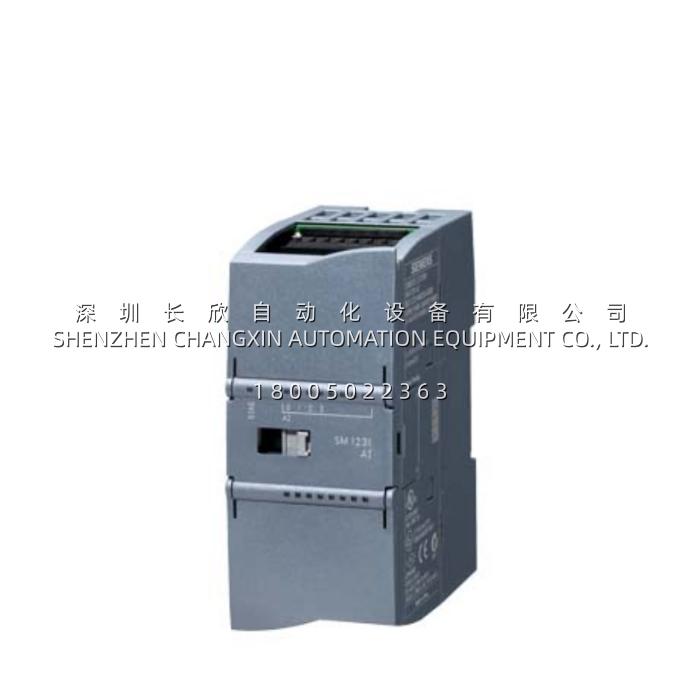
Product Overview
The 6ES7231-5QD30-0XB0 is a Siemens SIMATIC S7-1200 SM 1231 analog input module specifically configured for thermocouple (TC) temperature measurement and low-level voltage acquisition (±80 mV). It belongs to the S7-1200 signal-module family that expands a CPU 1211C/1212C/1214C/1215C/1217C with high-resolution temperature and mV-scale process signals, connecting to the CPU over the integrated S7-1200 backplane bus without separate communication wiring. While the broader SM 1231 lineup includes 4×13-bit and 8×13-bit voltage/current modules (±10 V, ±5 V, 0–20 mA, 4–20 mA), the 6ES7231-5QD30-0XB0 is the thermocouple-specialist variant: 4 differential input channels, each software-configurable in TIA Portal to any of nine TC types—J, K, T, E, R, S, N, C, and TXK/XK(L) per GOST—or to a raw ±80 mV voltage range for non-TC low-level transducers such as load-cell half-bridges, radiation pyrometer outputs, or pH-electrode amplifiers.
Resolution is specified as 15 bits plus sign (16-bit total word), with integrating measurement principle and parameterizable smoothing. The 6ES7231-5QD30-0XB0 performs automatic cold-junction compensation at the module-terminal block interface, eliminating the need for external compensation leads or manual offset entry; when the channel is configured to ±80 mV mode, CJC is automatically disabled since there is no thermoelectric junction to compensate. Destruction-limited input withstand is ±35 V on the TC/mV side, and the module provides 707 V DC (typ.,型式测试) reinforced isolation among field side / logic side / 24 V DC side, though channel-to-channel isolation is not present—channels share a common reference, requiring proper TC wiring practice (avoiding mixed ground potentials across channels).
Physically, the 6ES7231-5QD30-0XB0 follows the S7-1200 slim form factor: 45 mm wide, 100 mm high, 75 mm deep, ~180 g, snapping onto the DIN rail immediately to the right of the S7-1200 CPU or preceding signal module, with an alternative direct screw-mount option for high-vibration machinery where DIN-clip alone is insufficient. Current draw is modest—80 mA from the backplane 5 V DC bus and ~40 mA from the 24 V DC supply side, with 1.5 W typical power loss. Diagnostic coverage includes wire-break detection (for 4–20 mA on the voltage/current siblings; on TC mode the module watches for open-circuit TC via voltage drift beyond plausible range), 24 V DC undervoltage, and overflow/underflow per channel. With CE, c-Tick, and FM approvals, the 6ES7231-5QD30-0XB0 lands on panels from machine-building OEMs to process skids where S7-1200 is the designated controller and temperature fidelity matters.
Technical Specifications
| Parameter | Value |
|---|---|
| Product Model | 6ES7231-5QD30-0XB0 |
| Manufacturer | Siemens |
| Product Type | SM 1231 Analog Input Module – Thermocouple / ±80 mV, 4 AI |
| Number of Inputs | 4 (differential, shared reference) |
| Input Types | Thermocouple J, K, T, E, R, S, N, C, TXK/XK(L); ±80 mV voltage |
| Resolution | 15 bit + sign (16-bit total word) |
| Measurement Principle | Integrating (with parameterizable smoothing) |
| Conversion/Integration Time | Per-channel; noise suppression 85 dB at 50 / 60 / 400 Hz |
| Accuracy (25 °C / 55 °C) | ±0.1 % / ±0.2 % of full scale |
| Cold-Junction Error | ±1.5 °C (automatic CJC, disabled in ±80 mV mode) |
| Destruction Limit (input) | ±35 V (TC/mV side) |
| Input Impedance | ≥ 10 MΩ (voltage/mV mode) |
| Common-Mode Rejection (CMR) | >120 dB at 120 V AC |
| Isolation (typ. test) | 707 V DC: field↔logic, field↔24 V, 24 V↔logic; channel↔channel: none (shared ref) |
| Max Sensor Cable Length | 100 m (shielded) |
| Max Cable Resistance | 100 Ω |
| Backplane 5 V DC Current | 80 mA (typ.) |
| 24 V DC Current Consumption | 40 mA (typ.) |
| Power Loss (typ.) | 1.5 W |
| Operating Temp | 0 … +55 °C (horizontal), 0 … +45 °C (vertical) |
| Storage Temp | –40 … +70 °C |
| Dimensions (W×H×D) | 45 × 100 × 75 mm |
| Weight | ≈ 180 g |
| Mounting | 35 mm DIN rail (right of S7-1200 CPU) or direct screw-mount |
| Protection | IP20 |
| Approvals | CE, c-Tick, FM |
Main Features and Advantages
Nine TC types plus ±80 mV in one 45 mm slice. The 6ES7231-5QD30-0XB0 covers virtually every industrial thermocouple standardized in IEC 60584 and GOST: J (Iron-Constantan, food & plastics), K (Chromel-Alumel, general-purpose up to 1200 °C), T (Copper-Constantan, cryogenic/freezer), E (higher Seebeck, low temp), R/S (Pt-Rh, high-temp furnaces), N (K replacement with better drift), C (Tungsten-Rhenium, ultra-high temp), and TXK/XK(L) per GOST for CIS-region plants. The ±80 mV range adds versatility for non-TC low-level sources—a strain-gauge half-bridge preconditioning amp, a radiation-pyro mV output, or a pH electrode buffer—so one spare model covers both TC and specialty mV loops on a skid. All four channels are independently software-selectable in TIA Portal without jumpers; mixing a Type K on Ch0, Type J on Ch1, ±80 mV on Ch2, Type T on Ch3 is valid as long as the shared-reference grounding rule is respected.
Automatic cold-junction compensation without external hardware. A persistent pain point on TC loops is the “cold junction” at the terminal block where the TC alloy meets the copper PCB trace—every °C of terminal-temperature error injects the same °C error into the TC reading. The 6ES7231-5QD30-0XB0 carries a local temperature sensor at the terminal block and applies CJC in firmware, referenced to the TC type’s polynomial. The datasheet calls out ±1.5 °C cold-junction error, which combined with the ±0.1 % / ±0.2 % FS module accuracy puts a Type K reading at, say, 600 °C well within ±2–3 °C total—adequate for most process and machine-duty loops without buying external compensated transmitters. When the channel is switched to ±80 mV, CJC auto-disables because the input is a pure voltage, not a TC differential.
15+1 bit resolution with integrating converter and smoothing. The integrating A/D in the 6ES7231-5QD30-0XB0 rejects periodic noise by nature (integration window straddles the AC cycle), and Siemens adds software-smoothing (none/weak/medium/strong) configurable per channel. With 85 dB noise suppression at 50, 60, and 400 Hz, the module is inherently resistant to mains hum and VFD-switching harmonics that plague cheap delta-sigma front ends. For a furnace ramp or oven soak where the TC signal shouldn’t jitter, the strong-smoothing setting damps the LSB flicker without sacrificing too much step-response speed.
Built-in diagnostics that save truck rolls. The 6ES7231-5QD30-0XB0 pushes diagnostic alarms to the S7-1200 CPU over the backplane: overflow/underflow per channel (wires swapped? TC open? signal beyond ±80 mV?), 24 V DC supply low (upstream PSU sagging), and implicitly wire-break detection (on TC mode the open-circuit drives the amplifier to a rail voltage that the module flags). In TIA Portal, these map to the module’s diagnostic interrupt OB, so a maintenance screen can show “TC Ch2 open – check kiln zone 3 thermowell” rather than the operator seeing a frozen 32767 value and guessing. For plants still on paper logbooks, the front LED (green SF/OF pattern + channel-level readback) at least tells the electrician which bay to check.
S7-1200 ecosystem fit and compact footprint. At 45 mm, the 6ES7231-5QD30-0XB0 takes barely more rail space than a digital I/O module, so a CPU 1214C with two SM 1231 TCs, one SM 1232 AO, and a CM 1241 comms module still fits a 200 mm-wide enclosure. The module draws only 80 mA from the CPU’s 5 V backplane budget (CPU 1214C offers 1600 mA, so the 6ES7231-5QD30-0XB0 is ~5 % of that) and 40 mA from the 24 V DC rail—easy to feed from a SITOP 6EP1333-3BA00 5 A without breaking a sweat. Configuration is pure TIA Portal drag-and-drop: drop the 6ES7231-5QD30-0XB0 onto the device view, assign TC types, scaling (°C or °F), smoothing, alarm limits, done. No GSD files, no Profibus telegram wrangling—the backplane bus is proprietary S7-1200 and just works.
Shared-reference awareness (the one gotcha, handled correctly). The 6ES7231-5QD30-0XB0 does not have channel-to-channel isolation; all four inputs reference the same COM. This matters for TC wiring: if Ch0 measures a grounded-junction Type K on a steam trap and Ch1 measures a grounded-junction Type J on a different piece of equipment with a different earth potential, the loop currents through the COM pin can inject error. Siemens documents the mitigation—use floating (insulated) TC tips where possible, or isolate the “problem” loop with a milliamp transmitter (TC → transmitter → 4–20 mA → a standard SM 1231 AI, not the TC module). Calling this out in the features section is honest and useful; pretending channel isolation exists would be wrong.