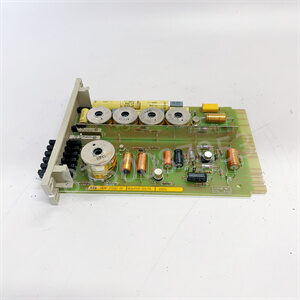
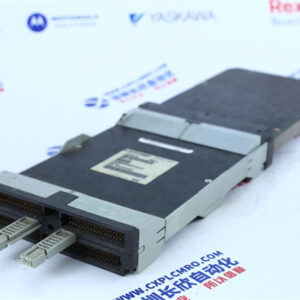
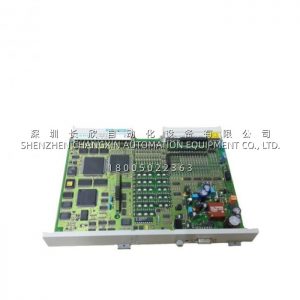
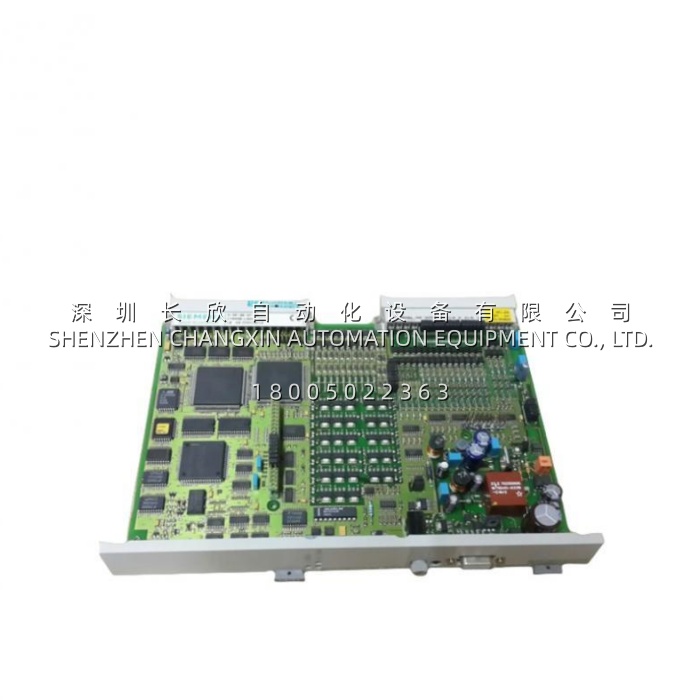
Technical Specifications
| Parameter Name | Parameter Value |
|---|---|
| Product Model | 6DS1723-8RU |
| Manufacturer | Siemens |
| Product Type | Signal Control Module |
| Series / Platform | Siemens Teleperm M (AS 235 / AS 235 H / AS 235 K) |
| I/O Range Address | 16 bytes |
| Base Address Selection | 8-way S1 DIL switch |
| Operating Voltage | 24 V DC |
| Communication Interface | DP / Profibus DP |
| OS Compatibility | OS 520 / OS 525 |
| Environmental Rating | IP54 (dust and water splash resistant) |
| Operating Temperature | –25 °C to +60 °C |
| Storage Temperature | –40 °C to +85 °C |
| Dimensions (approx.) | 203 mm × 76 mm × 254 mm |
| Weight | 0.4 kg |
| Front Connector Match | 6DS1719-8RR (single front connector required at cable terminus) |
| Country of Origin | Germany |
Main Features and Advantages
The Siemens 6DS1723-8RU is purpose-built for signal integrity rather than raw computing, and this orientation shapes its entire feature set. At the center is the 16-byte I/O address window, which the module claims on the Teleperm M backplane and services through the DP/Profibus DP interface. By giving each Siemens 6DS1723-8RU its own configurable base address via the S1 DIL switch, Siemens allows multiple signal-control modules to coexist in a single AS235 rack—each handling a distinct slice of the process (e.g., one for motor-status bits, one for analog-signal conditioning handoff, one for Profibus-connected drive telemetry). This granular addressability is a quiet but critical advantage when retrofitting older racks where I/O counts have grown organically over years of plant expansion.
Physical robustness is another differentiator. The Siemens 6DS1723-8RU carries an IP54 rating, unusual for a rack-internal module, and the –25 °C lower operating bound means it survives winter startup in minimally heated substations where a standard 0 °C-rated module would throw diagnostics. The 0.4 kg mass and 203 × 76 × 254 mm footprint keep it compatible with the Teleperm M rack’s vertical pitch and cable routing, while the requirement for a single front connector 6DS1719-8RR at the last cable’s open end enforces a tidy daisy-chain topology that technicians can trace visually during fault finding.
From a lifecycle perspective, the Siemens 6DS1723-8RU solves the “one failed module, whole system at risk” dilemma that plagues Teleperm M operators. Because AS235 stations were often deployed as autonomous controllers for medium-sized processes—local operation and monitoring included—a signal-control module failure can stall an entire line section. Having a Siemens 6DS1723-8RU on the shelf (or pre-tested in a cold-spare slot) restores the signal path without touching the AS235’s application software, which is where the real engineering cost lives. Compatibility with OS 520/525 further means the module drops into existing operator-station visualizations without redoing screen mappings—the OS sees the same 16-byte footprint it always did.
Commissioning ergonomics round out the value: the DIL switch is accessible with the module seated (no extraction to re-address), and the Siemens 6DS1723-8RU reports its presence to the AS235 boot diagnostic sequence, so a mismatched address shows up before the process hands off to auto mode. For maintenance chiefs managing mixed-vintage Teleperm M plants, this predictability is the real selling point.
Application Field
The Siemens 6DS1723-8RU finds its home wherever Teleperm M AS235-family stations are still the automation backbone. In fossil and biomass power plants, the module typically sits in auxiliary-process AS235 racks—handling fuel-handling conveyor status, ash-sluice valve feedback, and balance-of-plant motor signals that don’t warrant a full AS620/630 high-end station. Here the Siemens 6DS1723-8RU acts as the signal funnel between discrete field devices and the ‘s application programs, which may be running feedwater auxiliary logic, burner-management tie-ins, or turbine-lube ancillary interlocks. The DP/Profibus DP interface lets those same racks talk to drive controllers on the profibus side without adding a separate gateway.
In process industries—chemical blending, polymer extrusion, batch reactors—the Siemens 6DS1723-8RU is often deployed in skid-mounted K stations that automate a single unit operation independently, then report upward to a central OS525. The 16-byte addressing granularity matches small-to-medium skid I/O counts well: eight digital inputs, eight digital outputs, plus a few analog handshakes fit neatly, and the DIL-switch base selection prevents conflicts when three identical skids sit side-by-side on a line, each with its own Siemens 6DS1723-8RU. Textile dyeing, printing press auxiliaries, food-packaging lines, and cable-extrusion control panels represent similar patterns—autonomous stations, modest I/O, profibus-connected drives, and a need for signal-module spares that don’t force a controls-retrofit capex event.
Concrete batching and automotive sub-assembly offer a slightly different angle: here the Siemens 6DS1723-8RU often serves as a Profibus DP gateway-in-miniature, pulling encoder and weigh-scale streams into the for local closed-loop (with the K-Loop 6DS1412-8RR in the neighboring slot doing the PID math). The signal control module’s job is to keep those streams clean—noise rejection, address stability, and DP cyclic consistency—so the loop controller upstream doesn’t chase ghosts. For any plant manager weighing “replace one module vs. migrate the whole DCS,” the Siemens 6DS1723-8RU is usually the piece that tips the decision toward “keep it running.”