
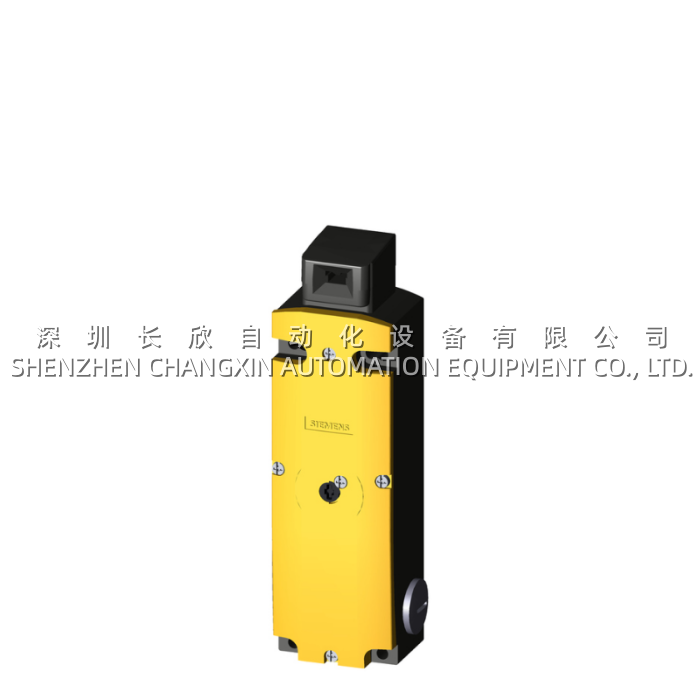
Application Scenarios
Consider a high-speed robotic packaging cell where operators must periodically access the enclosure for material replenishment. The risk of unexpected robot motion during this access creates a need for a robust, interlocked guarding system that is both safe and easy to troubleshoot. By deploying the Siemens 3SF1324-1SD21-1BA1 on the access doors, the engineering team integrates the guard locking directly into the AS-Interface network. The spring-locked mechanism ensures the door remains safely locked until the robot is in a safe state. When the AS-i master signals the switch to release, the 24V AC/DC actuator unlocks the door. Crucially, the 3SF1324-1SD21-1BA1 communicates its status (door open/closed, locked/unlocked) over the same two-wire cable, drastically reducing wiring complexity. This transforms a complex safety wiring challenge into a streamlined, intelligent control point, directly addressing the pain points of high installation costs and difficult fault-finding in traditional hardwired safety systems.
Parameters
| Main Parameters | Value/Description |
|---|---|
| Product Model | Siemens 3SF1324-1SD21-1BA1 |
| Manufacturer | Siemens |
| Product Category | Safety Position Switch with Guard Locking |
| Locking Force | 1300 N (provides secure holding under high vibration and impact forces) |
| Approach Directions | 5 (offers flexible actuator engagement for various mounting options) |
| Enclosure Material | Plastic (lightweight yet durable, ideal for control cabinet and machine mounting) |
| Connection Type | M12 Connector (standardized, facilitating quick and secure plug-in wiring) |
| Contact Configuration | Channel 1 (Actuator): 1 NC; Channel 2 (Magnet): 1 NC |
| Actuator Voltage | 24 V DC/AC (broad compatibility with standard control voltages) |
| Auxiliary Release | Front (allows for emergency manual unlocking from outside the hazardous area) |
| Safety Communication | ASIsafe (enables SIL 2 / PL d system-level safety when used with compatible monitors) |
| Monitoring Function | Actuator: 2 NC/1 NO; Magnet: 2 NC/1 NO (allows for detailed diagnostics) |
| Separate Actuator | 3SE5000-0AV0 (must be ordered separately, ensuring system integrity and flexibility) |
| Net Weight | Approx. 0.515 kg |
| Product Lifecycle | PM300: Active Product (ensures continued availability and support) |
Technical Principles and Innovative Values
Innovation Point 1: Direct Integration with ASIsafe for Intelligent Safety
The core innovation of the Siemens 3SF1324-1SD21-1BA1 is its integrated ASIsafe communication. Traditional safety switches require complex, costly hardwiring back to a dedicated safety relay. This switch, however, connects directly to the AS-Interface bus using a standard two-wire cable that carries both power and data. This enables safety-oriented communication, allowing the switch to not only perform its primary guarding function but also transmit detailed diagnostic data (e.g., actuator and magnet status) to a programmable logic controller (PLC) or AS-i safety monitor . This “smart” capability dramatically reduces installation time, simplifies troubleshooting, and enables predictive maintenance strategies.
Innovation Point 2: High Locking Force and Mechanical Flexibility
The 3SF1324-1SD21-1BA1 provides a robust locking force of 1300 N, ensuring that protective doors remain securely closed even under significant vibration and pressure. This makes it suitable for heavy-duty applications where operator safety is paramount . Furthermore, its design allows for 5 different approach directions for the separate actuator (3SE5000-0AV0), providing significant mechanical flexibility to accommodate various door types and mounting configurations .
Innovation Point 3: Tailored Safety Level & Diagnostics for Different Needs
This specific variant (1SD21-1BA1) offers a defined safety and diagnostic profile. It provides 1 NC contact for the actuator and 1 NC for the magnet. When evaluated with an AS-i safety monitor, it can achieve Safety Integrity Level (SIL) 1 or Performance Level (PL) c . A key characteristic of this variant is that, after the magnet is released and the door is unlocked, it requires the door to be physically opened and re-closed before the safety circuit can be re-established, forcing a deliberate operator action to ensure safety . This contrasts with variants that allow automatic