
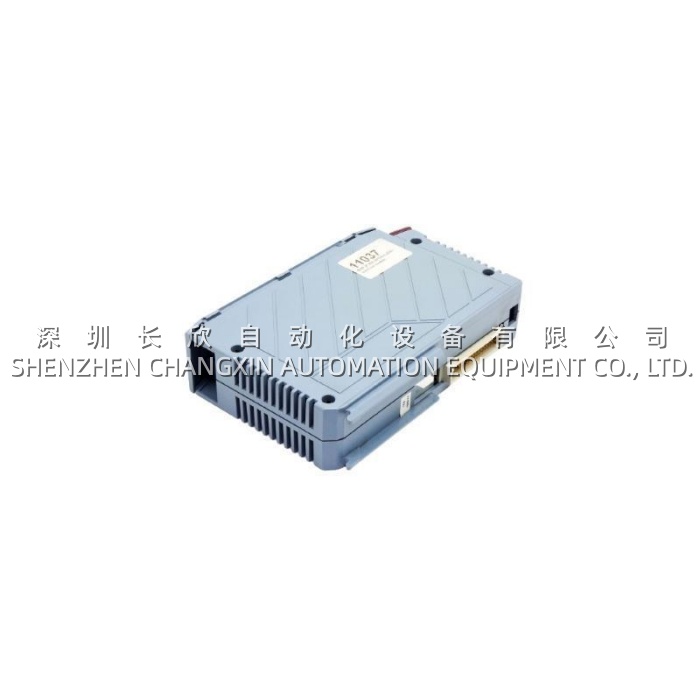
Application Scenarios
At a label-converting OEMS’s service call in Poland, a 2011-vintage die-cutter running a 2005 rack (3CP340 CPU + IF050 carrier) had lost comms to both the Sick barcode scanner (RS232) and the downstream reject-gate weigh scale (RS485). The original integrator had stuffed both devices onto a single RS232-to-USB dongle outside the cabinet—classic “save-a-port” hack—and when the dongle’s FTDI chip died during a humid August week, the line went down because the scanner couldn’t tell good labels from bad. The retrofit spec ditched the external dongle and dropped a B&R 3IF050.6-B.R into the IF050 slot that had been empty since commissioning. RS232 port 1 → barcode scanner, RS485/422 port → weigh scale daisy-chain (with a 0AC916.9 active terminator at the far end), RS232/TTY port left free for the service laptop. Ten minutes of wiring, five minutes in Automation Studio to assign the PVI COM handles, and the line was back. The plant E&I tech’s note: “Should’ve populated that IF050 slot years ago—the 3IF050.6-B.R cost less than the dongle we buried, and it’s inside the cabinet where it belongs.” This is the module’s real niche: it turns a bare 2005 CPU into a three-port serial hub without external protocol converters, USB fragility, or panel-space theft.
Parameter
| Main Parameters | Value/Description |
|---|---|
| Product Model | 3IF050.6-B.R |
| Manufacturer | B&R (ABB Robotics & Discrete Automation) |
| Product Category | Serial Communication Interface Module (System 2005) |
| Carrier / Slot | Plugs into IF050 system module interface slot (2005 rack) |
| Port 1 | 1× RS232 (DSUB-9, point-to-point: HMI, scanner, laptop) |
| Port 2 | 1× RS485/RS422, network-capable (DSUB-9, multi-drop: scales, drives, remote I/O) |
| Port 3 | 1× RS232/TTY (DSUB-9 / TTY current-loop capable) |
| Isolation | All interfaces electrically isolated (port-to-port + port-to-system-bus) |
| Supply Voltage | 24 V DC (via 2005 rack backplane, from CPU/PS) |
| Certifications | CE, UKCA, UL cULus E115267 (Industrial Control Equipment) |
| Operating Temp | 0 °C to +55 °C (IEC 61131 cabinet rating; storage –25 °C to +70 °C) |
| Mounting | IF050 carrier slot, 2005 rack (DIN/chassis) |
| Document | Datasheet 3IF050.6 1.0 (2004-06-08), DE |
Technical Principles and Innovative Values
- Innovation Point 1 — Three Isolated Ports on One 2005 Slot: The 2005 CPU’s system bus only has so many expansion avenues, and the IF050 carrier was B&R’s answer—populate it with a 3IF050.6-B.R and you get + RS485/422 + /TTY without burning a second CPU slot or going to external gateway boxes. All three ports are galvanically isolated from each other and from the 2005 backplane, so a +24 V short on the RS485 scale loop won’t propagate to the HMI or the CPU’s system bus.
- Innovation Point 2 — RS485/422 “Network-Capable” Port for Multi-Drop: Port 2 isn’t just a point-to-point UART—it’s spec’d for multi-drop networking (daisy-chain with 120 Ω termination at both ends). This is what lets a single 3IF050.6-B.R talk to a string of 8–12 weigh scales, drives, or remote terminal strips along a machine frame without extra repeaters. Pair it with the 0AC916.9 active terminator if your drop stretches beyond 50 m or runs past VFD-heavy skids.
- The TTY current-loop capability on Port 3 is a nod to older European machine tools and printers that still speak 20 mA current-loop TTY. Most modern USB-serial dongles can’t do TTY without extra circuitry; the 3IF050.6-B.R carries it natively, which is why you still see these on 1990s/2000s vintage press retrofits where the printer or indenter never got upgraded.
- Innovation Point 4 — Zero-Software-Overhead Integration: Because the 3IF050.6-B.R hangs off the carrier, the 2005 CPU sees the three ports as standard PVI COM handles—no custom function blocks, no third-party DLLs. In Automation Studio, you drag the + 3IF050.6 into the 2005 configuration, set baud/parity per port (up to 115.2 kbps typical on , 500 kbps+ on depending on cable), and you’re done. For SIs maintaining 15-year-old machines, that “it just enumerates” quality is worth more than any bandwidth number.