
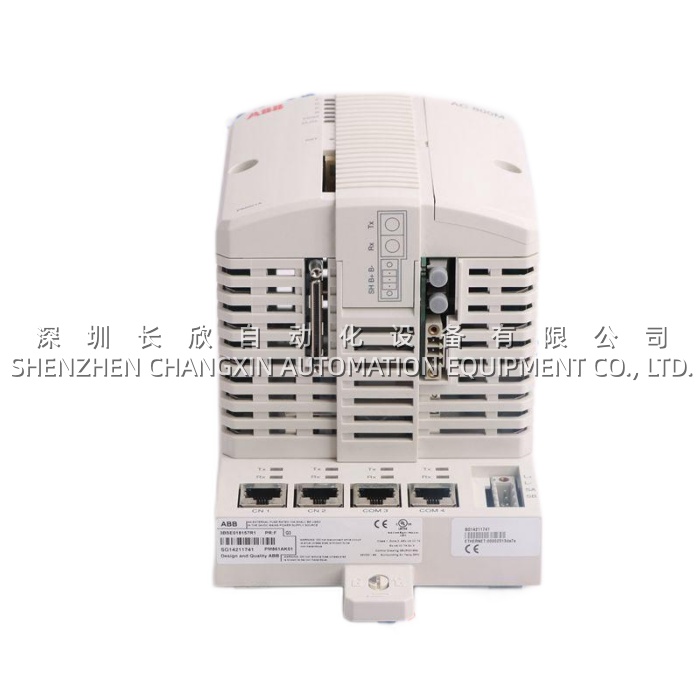
Application Scenarios
At a body-shop in a German OEM plant running 32 IRB 6640 arcs on IRC5 cabinets, the night shift logged three “Power Module Fault” and two spontaneous DSQC CPU resets on Line 7 within a single week—always around hour 16 of a 3-shift run, never reproducible cold. The integrator’s first instinct was a flaky DSQC 643 board, but the pattern pointed elsewhere: the ABB 3HAC14549-3-03A in that cabinet was the original 2008 unit, and the +5 V rail’s ripple, when measured hot, was hovering at ~120 mV p-p—borderline for the DSQC’s CPU reset threshold. The +24 V/20 A rail to the I/O slices was also sagging under the paint-shop heat (cabinet ambient regularly hit 42 °C, and the rectifier’s intake filter hadn’t been changed in two years). Swapping in a fresh ABB 3HAC14549-3-03A (and fitting a new cabinet intake filter while the door was open) brought the +5 V ripple back under 40 mV, and the DSQC resets vanished. The maintenance lead’s post-mortem note: “The robot arm gets all the glory, but the R3 rectifier is what actually keeps the brain fed.” For any plant sitting on 10+ year IRC5 fleets, the ABB 3HAC14549-3 is one of those “replace-before-it-fails” items that pays for itself the first time you don’t have to reboot a welding cell at 2 a.m.
Parameter
| Main Parameters | Value/Description |
|---|---|
| Product Model | 3HAC14549-3 (R3 rectifier; variants: -03A / /10A) |
| Manufacturer | ABB |
| Product Category | Rectifier / Control-Cabinet AC-DC PSU (IRC5) |
| Applicable System | ABB IRC5 robot controller (M2004/M2005) |
| Compatible Robots | IRB 1600, IRB 2600, IRB 4400, IRB 6640, IRB 7600 |
| Input Voltage | 3×400 V AC (±10%), 50/60 Hz (typical; some versions 200–240 V AC) |
| Output ( /10A variant ) | 24 V DC @ 10 A (≈240 W), single rail |
| Output ( -03A variant ) | +5 V/30 A +12 V/5 A +24 V/20 A (≈750 W total) |
| Efficiency | ≥90% (single-rail) / ≥85% (multi-rail -03A) |
| Protection | Input OV/UV, output OL/short (auto-recovery), OTP |
| Cooling | Forced-air fan (speed proportional to load) + convection |
| Indicators | Front-panel LEDs: PWR, ALM |
| Mounting | 19″ rack rail (IRC5 R3 section), panel screws |
| Operating Temp | 0 °C to +45 °C (cabinet rating; derated above 40 °C) |
| Dimensions ( /10A ) | ~120 × 80 × 40 mm |
| Weight | ~1.7–1.8 kg (varies by suffix) |
| Certifications | CE, UL, RoHS, IEC/EN 60204-1, IEC/EN 61800-5-1 |
⚠️ Variant Check Before Ordering
The ABB 3HAC14549-3 base number covers two electrically different builds. The /10A suffix is a single 24 V/10 A (~240 W) rectifier—typically the smaller R3 unit feeding control voltage to I/O, sensors, and cabinet peripherals. The -03A suffix is the multi-rail 750 W switch-mode PSU (+5 V/30 A for the DSQC main board, +12 V/5 A for logic, +24 V/20 A for I/O & fans). They are not inter-drop-in—putting a /10A where a -03A lived will leave the DSQC board unpowered, and vice versa will over-provision a slot that only needed 24 V/10 A. Always check your cabinet’s R3 BOM sticker before buying.
Technical Principles and Innovative Values
- Innovation Point 1 — Power-Sequencing Tuned for DSQC Timing: The ABB 3HAC14549-3-03A doesn’t just dump DC onto the rail—its +5 V, +12 V, +24 V rise times and sequencing are tuned to the DSQC main-board power-good window. This prevents the “CPU resets on cabinet reclose” nuisance that generic 24 V supplies cause on IRC5 racks, where the DSQC expects +5 V to stabilize before the logic rails assert.
- Innovation Point 2 — Load-Proportional Fan Mapping: The forced-air fan on the ABB 3HAC14549-3 isn’t fixed-speed. Internal temperature sensing ramps the fan with load and ambient, which keeps the +5 V rail’s electrolytic caps from cooking in hot paint-shop cabinets while keeping acoustic noise down during light-duty shifts. This is directly why the -03A units routinely hit 12–15 year service life in climate-controlled body shops but die in 6–8 years in unfiltered foundry skids.
- Innovation Point 3 — Auto-Recovery OL/Short on Each Rail: Each output on the ABB 3HAC14549-3-03A has independent current limiting with auto-recovery hiccup mode. If a DSQC 652 I/O slice develops a shorted sensor feed on the +24 V rail, that rail folds back while +5 V and +12 V stay up—so the robot’s controller stays alive to log the fault instead of hard-crashing. On the /10A single-rail version, the same auto-recovery protects the control loop from a stuck 24 V payload.
- Innovation Point 4 — Front-Panel PWR/ALM LEDs as First-Line Diagnostics: No laptop needed to tell “supply dead vs. downstream short” on an R3. The ABB 3HAC14549-3‘s ALM LED latched on = over-temperature or pre-alarm on the rectifier itself; PWR lit but ALM dark while the DSQC won’t boot = check the +5 V rail’s mating connector (the classic “one pin oxidized” failure on 15-year-old R3 racks).
Application Cases and Industry Value
A tiered automotive seat-assembly line in Mexico running 18 IRB 2600s on had adopted a “run-to-fail” policy on R3 rectifiers—the parts were “only $X” and the line had redundancy. That policy broke during a July heatwave when three cabinets within 36 hours tripped “Power Module Fault” and took the cell down. Two were ABB 3HAC14549-3/10A (24 V/10 A control rail) feeding the DSQC 652 I/O slices—the intake filters were clogged with seat-foam dust, the rectifier fan ran constant-high, and the +24 V rail folded back on OTP. The third was a ABB 3HAC14549-3-03A whose +5 V rail had drifted low enough to cause intermittent DSQC watchdog trips during the afternoon peak. The plant converted to a “replace-at-10-years” policy, stocked two /10A and two -03A per 10 robots, and added “R3 fan-filter check” to the quarterly PM. Over the next 24 months, zero R3-related cell stops. The maintenance superintendent’s math: the four spare rectifiers cost less than one unplanned downtime hour on a seated-track line. That’s the real value of keeping the ABB 3HAC14549-3 on the CMMS radar—it’s not a glamorous part, but it’s the one that decides whether “robot fault” becomes “line down.”