Technical Specifications
| Parameter Name | Parameter Value |
|---|---|
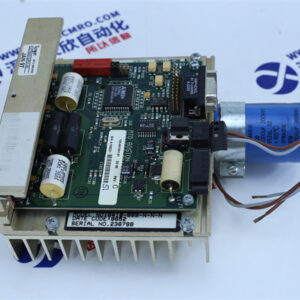
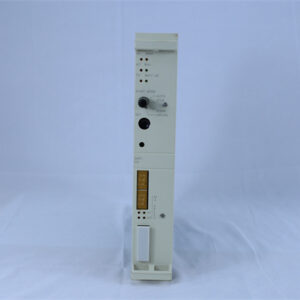
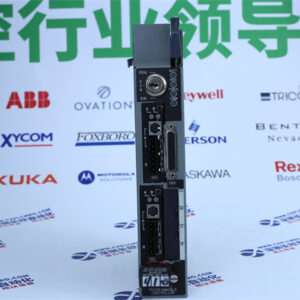
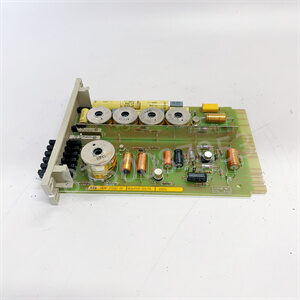
| Product Model | UCD240A01 (3BHE022287R0001) |
| Manufacturer | ABB |
| Product Type | CCM / CCI – Control & Conversion Module (Excitation Controller) |
| Applicable System | ABB UNITROL 6000, UNITROL 6800, UNITROL 6080 retrofit paths; ACS6000 MV drive CCM rack compatible |
| Processor | 32-bit RISC, PEC80 platform |
| Supply Voltage | 24 V DC (backplane-powered, 18–32 V DC range) |
| Power Consumption | ≤ 15 W (typical 8–12 W) |
| Analog Inputs | PT 0–100 V AC; CT 0–5 A AC; rotor-current sense ~200 mV DC |
| Sampling Accuracy | ±0.1 % FS (PT/CT channels) |
| Trigger Output | Fiber / electrical pulse to thyristor bridge via PBA/PBT → PDD405A101 |
| Local Communication | RS-485 (Modbus RTU), CANopen |
| DCS-side Communication | Ethernet TCP/IP (IEC 60870-5-104; Profibus DP optional per config) |
| Redundancy | 1:1 Hot Standby CCI, auto-switch <100 ms, no-disturbance transfer |
| Isolation Voltage | ≥ 1500 V AC (analog/digital channels vs. system side) |
| Status Indicators | Front-panel LEDs: RUN / ERR / COM / Redundancy |
| Operating Temperature | –10 °C to +55 °C (cabinet-internal, per UNITROL spec) |
| Storage Temperature | –40 °C to +85 °C |
| Humidity | 5–95 % RH, non-condensing |
| Mounting | Plug-in to UNITROL CCI dedicated slot (guide-pin + latch) |
| Dimensions (L × W × H) | 247 × 30 × 270 mm |
| Weight | Approx. 0.92 kg |
| Protection Class | IP20 (cabinet internal) |
| Certifications | CE, UL, IEC 60255, IEC 61000-6 (EMC) |
Main Features and Advantages
Excitation-Grade Control Architecture. The ABB 3BHE022287R0001 is not a generic PLC card—it is a PEC80 32-bit RISC execution engine tuned for the AVR control law, limiter cascade (OEL, UEL, stator-current limit), and power-system stabilizer (PSS) blocks that keep a synchronous generator stable on a weak grid. For plants running large thermal or hydro units, the deterministic loop closure on the UCD240A01 directly impacts how fast the generator recovers terminal voltage after a grid disturbance. Swapping a degraded CCM for a fresh ABB 3BHE022287R0001 restores that loop integrity without retuning the AVR gains, because the application firmware lives in the UNITROL project file, not on the board EEPROM alone.
High-Accuracy Metering Front-End. PT (100 V) and CT (1 A / 5 A) channels on the UCD240A01 are specified at ±0.1 % FS, which matters because the AVR compares sensed terminal voltage against a very tight regulation band (often ±0.5 % steady-state). If the CCM’s analog front-end drifts after 10+ years of service, the generator can show slow voltage creep or oscillatory behavior that gets misdiagnosed as a grid issue. Keeping a spare ABB 3BHE022287R0001 on the shelf lets maintenance replace the entire metering+control chain in one move during a planned outage.
Fiber Trigger Path. The UCD240A01 dispatches firing pulses to the thyristor power bridge over fiber (via PBA/PBT trigger boards downstream to PDD405A101 distribution). This keeps gate-drive noise away from the 24 V logic domain and makes the ABB 3BHE022287R0001 immune to the ground-transient events that routinely occur when a bridge leg misfires or a crowbar operates. In retrofit stories where an older CCI was driving the bridge electrically and logging sporadic “trigger loss” events, migrating to the fiber-path UCD240A01 architecture often clears the alarm pattern.
Hot-Standby Redundancy. For single-CCI configurations, the failure mode is “excitation lost → generator trip.” For dual-CCI with two ABB 3BHE022287R0001 modules, the peer takes over in <100 ms with no terminal-voltage step—essentially invisible to the grid. Best practice documented by ABB spare-part distributors: dual-CCI units should carry at least one on-site buffer spare; single-CCI units must carry one minimum. The UCD240A01 supports this model natively; LED coding (RUN / ERR / COM / Redundancy) lets the control-room operator see which CCI is active and whether the standby has synchronized.
G3 coating and Swap-and-Go. The board carries conformal coating rated for G3 corrosive environments (coastal plants, desalination, fertilizer/chemical plants). Combined with backplane auto-enumeration, a replacement ABB 3BHE022287R0001 typically goes from “box opened” to “green RUN LED” in under 15 minutes. No laptop required unless you want to verify the project CRC. This is a deliberate ABB design choice: in a turbine trip event, you don’t want the electrician hunting for a laptop and a GSD file—you want a board swap and a green light.
Cross-Generation Caveat. The ABB 3BHE022287R0001 () supersedes earlier CCI generations such as PCD231B101, but firmware and rack-version interop is not fully transparent—ABB advises against mixing with early PCD231 builds in the same redundant pair. If your cabinet still runs PCD231B101 and you’re buying a cold-spare , confirm with ABB which firmware branch your rack expects before plugging it in. This is the one “watch-out” that recurring spare-part posts emphasize.