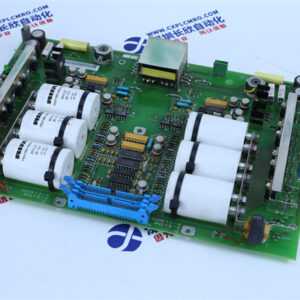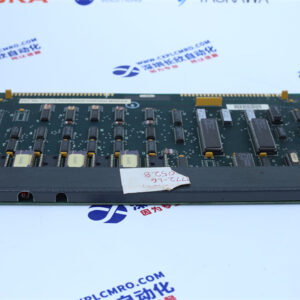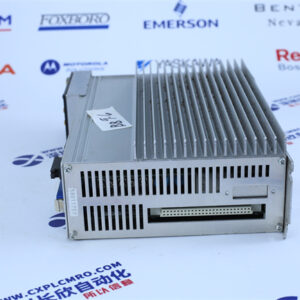
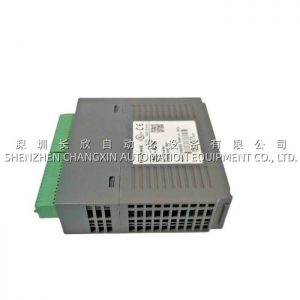
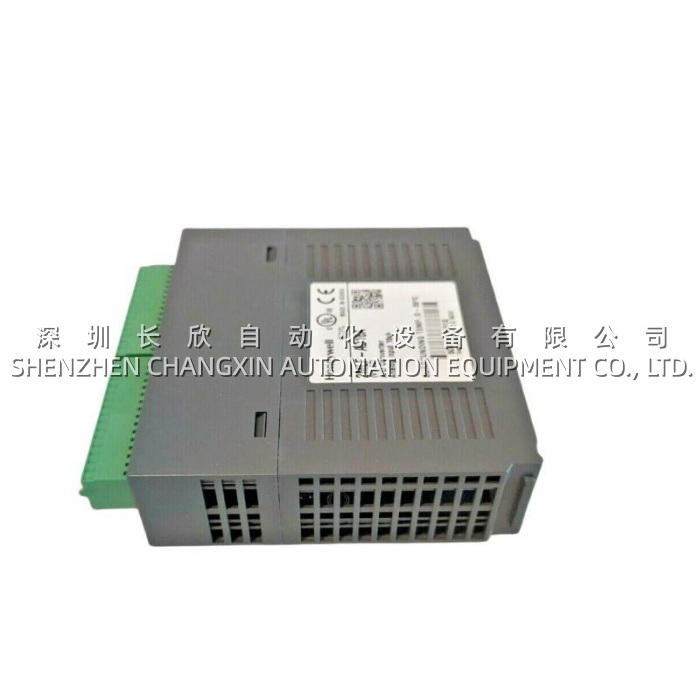
Application Scenarios
In a municipal wastewater treatment plant running a MasterLogic-200–based SCADA, the aeration basin zone had 14 field loops that were a messy mix: 6 × 4–20 mA dissolved-oxygen probes, 4 × 0–10 V turbine flowmeters, and 4 × ±10 V redox ORP sensors from an older German skid that the plant couldn’t afford to re-transmitter. The original panel used three separate 8-channel AI cards (two current-only, one voltage-only), burning three rack slots and forcing the instrument techs to juggle two different terminal layouts. The retrofit swapped all three for two 2MLF-AD16A modules — because every channel on the 2MLF-AD16A can be independently set to current or voltage range via the range DIP or software, the techs mapped DO-probe channels to 4–20 mA, flowmeters to 0–10 V, and ORP to ±10 V, all on the same 32-point terminal strip. Post-commissioning, the plant shaved 18% off loop-check time (one terminal style instead of three), and the 2MLF-AD16A‘s 500 µs/ch scan meant the aeration PID no longer lagged behind the DO probe’s 2 Hz ripple — sludge settleability improved enough to cut polymer dosing by 6%. This case captures the module’s sweet spot: mixed-signal skids where dedicating separate voltage-only (AV8A) and current-only (AC8A) cards would waste rack real estate and complicate marshalling.
Parameter
| Main Parameters | Value/Description |
|---|---|
| Product Model | 2MLF-AD16A |
| Manufacturer | Honeywell (MasterLogic-200 Series) |
| Product Category | 16-Channel Analog Input (A/D) Module |
| Input Channels | 16. independently configurable V or I per channel |
| Voltage Ranges | 1–5 V, 0–5 V, 0–10 V, ±10 V DC |
| Current Ranges | 4–20 mA, 0–20 mA DC (250 Ω input burden) |
| Resolution / Accuracy | 1/16000 (16-bit); ±0.2% @ 25±5°C, ±0.3% @ 0–55°C |
| Conversion Speed | 500 µs per channel |
| Input Impedance | ≥ 1 MΩ (voltage mode), 250 Ω (current mode) |
| Isolation | Photocoupler: terminals ↔ PLC backplane (channel-to-channel NOT isolated) |
| Power / I/O Allocation | 5 V DC, 330 mA (backplane); Fixed 64 pt / Variable 16 pt address modes |
| Operating Conditions | 0°C to +55°C; 5–95% RH non-condensing; DIN/rack mount; ~115 g |
Technical Principles and Innovative Values
Innovation Point 1: Per-Channel Mixed V/I Configurability. Unlike the AV8A (voltage-only, 8 ch) and AC8A (current-only, 8 ch) siblings, the 2MLF-AD16A lets you assign each of its 16 channels independently to either a voltage or current range via DIP switches or MasterLogic-200 configuration software. This collapses three traditional 8-ch cards into one 16-ch slot when your skid has a heterogenous sensor mix — a huge deal for water/wastewater, pharma bioreactors, and packaged OEM skids where panel footprint is tight.
Innovation Point 2: 16-bit SAR ADC at 500 µs/Ch with 1/16000 Granularity. The 2MLF-AD16A uses a successive-approximation register (SAR) architecture that delivers 500 µs throughput per channel — meaning a full 16-channel scan completes in 8 ms. At 1/16000 resolution, 0–10 V maps to 0.625 mV/LSB and 4–20 mA (across 250 Ω → 1–5 V span) maps to ~0.25 µA/LSB. For comparison, many competitor “16-ch AI” cards in this class stall at 1/4000 and 1–2 ms/ch — the 2MLF-AD16A punches above its rack level.
Innovation Point 3: Photocoupler Isolation + 32-Point Terminal Economy. The input terminals are photocoupler-isolated from the ML200 backplane (protects the 5 V logic side from field-side transients), and the entire 16-channel set lands on a single 32-point terminal strip (each channel = +/–). This halves the terminal-count versus 8-ch cards (which still need 16–20 points each) and keeps wire dressing clean — a detail panel builders notice on Day 1.
Innovation Point 4: Dual I/O Address Allocation Modes. The 2MLF-AD16A supports both “Fixed 64-point” (each channel consumes 4 words — status + raw + eng-units + offset) and “Variable 16-point” (each channel compresses to 1 word, sacrificing some diagnostic depth). This lets system integrators trade debug visibility for address-map compactness when the ML200’s I/O image area is under pressure — a flexibility most 16-ch AI modules don’t advertise.
Application Cases and Industry Value
Case 1 – Pharma Biologics Pilot Plant, Central Europe. A stainless-steel 500 L bioreactor skid controls 16 loops: 8 × PT100 4–20 mA temp transmitters, 4 × 0–10 V load-cell bridges for broth weight, and 4 × ±10 V pH/DO Ag/AgCl probes (legacy European vendor, ±10 V is their native). The OEM originally specced two 2MLF-AC8A + one 2MLF-AV8A, but rack space on the skid-mounted ML200 panel was maxed. The integrator swapped to two 2MLF-AD16A modules — all 16 loops on one card, mixed ranges assigned in software. Commissioning revealed the 2MLF-AD16A‘s ±0.2% accuracy was well within the bioreactor’s ±0.5% temp/sp + ±0.1 pH requirement. The validation engineer noted: “We passed FDA data-integrity review on the first pass because the 2MLF-AD16A‘s 16-bit raw values gave us better than 0.01 pH LSB — no extra signal conditioner boxes needed.”
Case 2 – Cement Plant Raw Mill, Southeast Asia. The mill’s roller-pressure lubrication skid has 12 × 4–20 mA pressure transmitters and 4 × 0–10 V vibro-accelerometer boxes (old SKF nodal system). Previously on a Siemens S7-300 SM331 rack, the plant migrated to ML200 for spare-parts commonality with their new clinker cooler DCS. The 2MLF-AD16A absorbed all 16 signals in one slot — the 500 µs scan caught a roller-overpressure transient that the old 2 ms S7 card missed, triggering an early lube-pump ramp-up that prevented a bearing seizure. Maintenance lead: “That one catch paid for the whole ML200 retrofit.”
Related Product Combination Solutions
Building an ML200 rack around the 2MLF-AD16A? These siblings commonly cluster with it:
2MLF-AV8A – 8-channel voltage-only AI (1–5 / 0–5 / 0–10 / ±10 V); use when you have a pure voltage-density need and want to free 2MLF-AD16A slots for mixed loops.
2MLF-AC8A – 8-channel current-only AI (4–20 / 0–20 mA); the inverse of AV8A, often paired with 2MLF-AD16A in large plants where segregation simplifies range-DIP discipline.
2MLF-AD8A – 8-channel mixed V/I (the half-density version of 2MLF-AD16A); useful for small skids where 16 ch is overkill but you still want mixed-range flexibility.
2MLF-AD4S – 4-channel mixed V/I with channel-to-channel isolation; step up to this if your 2MLF-AD16A‘s terminal-only isolation isn’t enough (e.g., floating sensors on different grounds).
2MLF-DC4A – 4-channel analog output (4–20 / 0–20 mA); the natural AO companion when your 2MLF-AD16A reads the PV and you need a 4–20 mA OUT to a VFD or control valve.
2MLF-DV4A – 4-channel voltage output (1–5 / 0–5 / 0–10 / ±10 V); partner AO for drives that want 0–10 V speed reference.
2MLQ-TR2B / TR4B – ML200 transistor output (16 / 32 ch, sink/source); the DO sibling filling out the same rack as your 2MLF-AD16A.