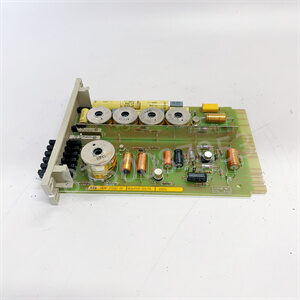
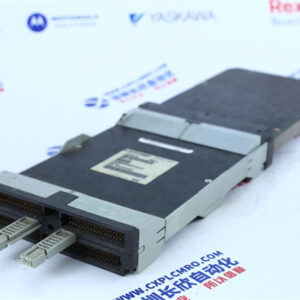

Technical Specifications
| Parameter Name | Parameter Value |
|---|---|
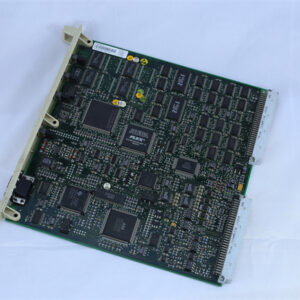
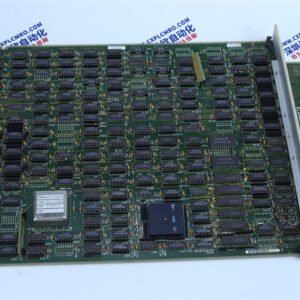
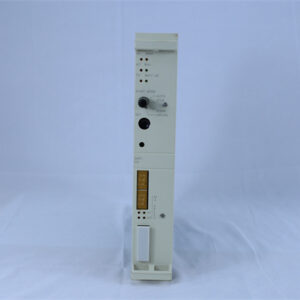
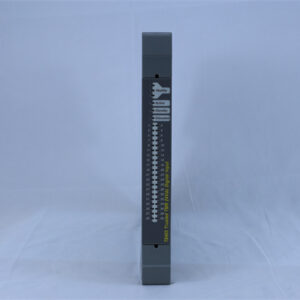
| Product Model | 1C31232G01 |
| Manufacturer | Westinghouse (Emerson Ovation family) |
| Product Type | Digital Input Module, 16-Channel, 24/48 V DC |
| Compatible System | Emerson Ovation DCS (base I/O chassis); WDPF/PROVOX migration target |
| Input Voltage Range | 24 V DC / 48 V DC (wet or dry contact) |
| Input Type | Single-ended, NPN/PNP compatible (auto-sense per Ovation gen) |
| Number of Channels | 16 |
| Channel Isolation | Channel-to-channel, optical |
| Response Time | < 5 ms typical |
| Operating Temperature | -40 °C to +70 °C |
| Storage Temperature | -40 °C to +85 °C |
| Humidity | 5–90 % RH, non-condensing |
| Mounting Method | Ovation I/O chassis / DIN rail (panel) |
| Protection Rating | IP20 |
| Hot-Swap Support | Yes (live replacement, chassis permitting) |
| Dimensions (approx.) | 45 × 125 × 110 mm (W × H × D) |
Main Features and Advantages
24/48 V DC dual-range flexibility:
Most DCS DI cards commit to one coil voltage, forcing mixed-voltage panels to carry two SKUs. The Westinghouse 1C31232G01 accepts 24 V DC and 48 V DC on the same 16-channel body — wet (sourced) or dry (contact) — which means a retrofit crew can land legacy 48 V DC MCC aux-feedback and newer 24 V DC prox on the same module without re-laddering the chassis BOM. For WDPF→Ovation migrations especially, this halves the SKU count on the DI row.
Channel-to-channel optical isolation:
Each of the 16 inputs on the Westinghouse 1C31232G01 rides its own optocoupler, rated for robust channel-to-channel isolation. In a turbine-deck panel where homeruns from different MCCs, different transformer secondaries, and different earth references all terminate on the same DI block, that isolation keeps a ground-loop event on channel 3 from flipping channel 11 or glitching the Ovation backplane. The Westinghouse 1C31232G01 also carries input-to-ground isolation in the kilovolt class, which matters when the field cable runs parallel to a 4160 V feeder for 50 m.
Hot-swap without controller interrupt:
The Westinghouse 1C31232G01 is designed for live replacement — pull the faulty unit, seat the new one, the Ovation chassis backplane re-enumerates the module and the controller picks the 16 points back up. On a unit-rated plant where a DI rack sits in a balance-of-plant aux building and the turbine can’t trip for a card swap, that capability moves the Westinghouse 1C31232G01 from “nice to have” to “specified.” Note: hot-swap assumes the Ovation chassis power and backplane are healthy — if the chassis PS is already marginal, swap with the controller in secondary or during a scheduled clearance.
WDPF / PROVOX migration path:
The Westinghouse 1C31232G01 is not a WDPF card, but it is the Ovation-native DI that WDPF离散 inputs migrate into. Field wiring (24/48 V DC discrete) from the WDPF panel re-terminates to the Westinghouse 1C31232G01 terminal block; the Ovation Developer Studio project maps the new module’s point offsets; the old WDPF DI rack is de-racked. For plants doing phased migration (keep WDPF RIO drops alive on Ovation bridge, replace base-rack DI with Westinghouse 1C31232G01), this module is the workhorse SKU — active lifecycle from Emerson, so forward procurement is viable for 5+ year roadmaps.
Diagnostic and LED visibility:
Each channel on the Westinghouse 1C31232G01 has an LED indicator (standard Ovation DI pattern), so a panel walkthrough answers “is the limit switch actually closing or is the DI not seeing it?” without a laptop. Module-level health LED reports backplane comm and internal diag; if the Westinghouse 1C31232G01 detects an internal fault (opto array, backplane transceiver), it signals the Ovation controller which can drive a maintenance alarm before the point fully drops. That “fail-reported” behavior is what lets the control-room operator call the electrician with “channel 7 on rack B3 is drifting,” not “B3 rack is dark.”
Environmental headroom:
Rated -40 to +70 °C, the Westinghouse 1C31232G01 covers freezer-store aux panels (where Ovation serves KR palletizers in cold-chain) through steam-tunnel vestibules where ambient creeps past 60 °C. 5–90 % RH non-condensing matches unconditioned electrical rooms in older plants. IP20 keeps it cabinet-only, which is correct — the Westinghouse 1C31232G01 lives in the Ovation chassis behind the cabinet door, not in a field enclosure.
Application Field
The Westinghouse 1C31232G01 is an Ovation base-rack DI, so its application field splits between greenfield Ovation cells and — more visibly — WDPF/PROVOX brownfield migrations. In unit-rated coal/nuclear/gas plants that standardized on WDPF in the 1990s and are now mid-Ovation migration, the Westinghouse 1C31232G01 populates the new Ovation I/O chassis in the MCR or the balance-of-plant aux buildings. Typical points landed on the Westinghouse 1C31232G01 include pump “run / fault / trip” aux from MCCs (often 48 V DC dry contact, hence the 48 V range matters), valve limit-switch feedback (24 V DC wet from panel-mounted PSU), burner-management system flame-scan “proof of fire” contacts, and turbine auxiliary interlocks that the Ovation controller needs within one scan. Because the Westinghouse 1C31232G01 is 24/48 dual-range, the same chassis can mix MCC-dry and PSU-wet points without splitting SKUs — a common pattern in BOP aux panels where the original WDPF design already had that mix.
In refinery and petchem CDU/VDU units that ran Fisher PROVOX and are migrating to Ovation, the Westinghouse 1C31232G01 lands the 24 V DC discrete field — ESD pushbutton loops, motor-operated-valve limit cams, compressor aux-feedback — re-terminated from the PROVOX marshalling into the Ovation chassis. The hot-swap capability of the Westinghouse 1C31232G01 matters here because refinery units run 3-shift and an I/O card swap can’t always wait for a turnaround window; the electrician pulls the faulted Westinghouse 1C31232G01 live, seats the spare, and the Ovation controller re-acquires the 16 points in seconds.
Water/wastewater and biomass cogeneration — smaller Ovation footprints — also use the Westinghouse 1C31232G01 when the field devices are 24 V DC (float switches, pressure-switch NO/NC, VFD fault relays). The 16-channel density is efficient for skid-mounted Ovation chassis where rack slots are scarce. For spare-parts managers, the application takeaway is straightforward: anywhere the plant has an Ovation base I/O chassis and the field is 24 or 48 V DC discrete, the Westinghouse 1C31232G01 is on the BOM — and on the critical-spare list for hot-swapable DI.