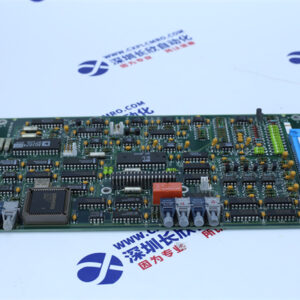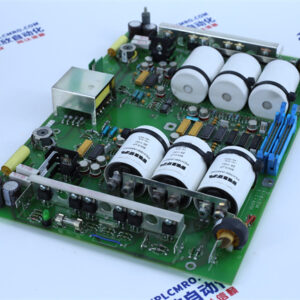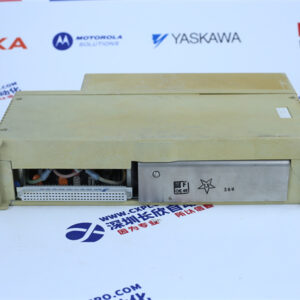
Technical Specifications
| Parameter Name | Parameter Value |
|---|---|
| Product Model | 1C31203G01 |
| Manufacturer | Westinghouse Electric (Emerson Ovation DCS portfolio) |
| Product Type | Remote Node Controller (RNC) |
| Compatible System | Emerson Ovation DCS |
| Processor | 32-bit ARM Cortex-A9 |
| Memory | Up to 1 GB DDR3 |
| Storage | Up to 16 GB NAND Flash |
| Communication Interface | Ovation high-speed redundant bus, fiber or copper (coax) |
| Communication Rate | 100 Mbps (typical) |
| Supported I/O Types | Digital, Analog, RTD, Pulse, Relay (via local I/O base) |
| Redundancy | 1:1 redundant pair support, <100 ms hot-switchover |
| Power Supply | 24 VDC |
| Operating Temperature | 0 °C to +60 °C |
| Storage Temperature | -40 °C to +85 °C |
| Relative Humidity | 5% to 95%, non-condensing |
| Mounting | Remote I/O cabinet / DIN-rail compatible chassis slot |
| Weight | Approx. 1.5 kg |
| Protection Class | IP20 (cabinet-mounted) |
Main Features and Advantages
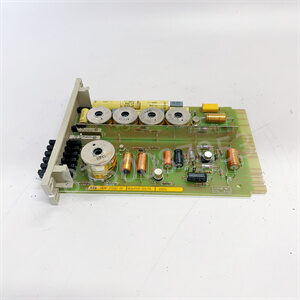
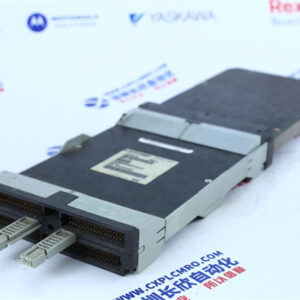
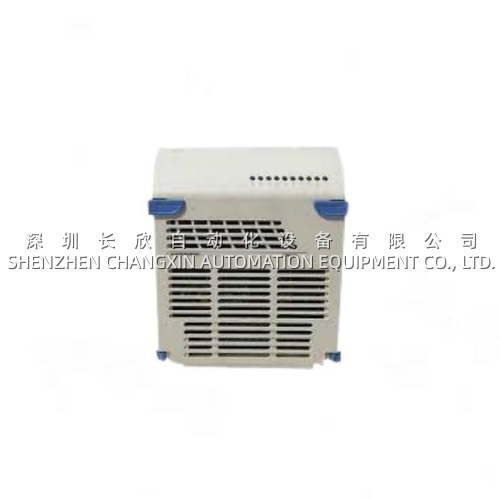
Remote I/O concentration with DCS-grade determinism. The 1C31203G01 lets a plant push I/O physically closer to the field — burner management cabinets on a boiler front, turbine aux relay panels, SCR ammonia-injection skids — without sacrificing the scan-time guarantees Ovation controllers expect. By aggregating dozens of digital and analog points locally and forwarding packed frames over the redundant Ovation bus, the 1C31203G01 cuts homerun cable counts dramatically and keeps signal noise manageable on long runs.
1:1 redundancy with sub-100 ms failover. In continuous-process environments — especially power generation — a single RNC failure cannot be allowed to orphan an entire I/O cabinet. The 1C31203G01 supports a primary/backup pair on the same backplane; if the active unit loses power, bus, or self-diagnoses a fault, the standby takes over in under 100 ms. Control logic in the upstream OCR never sees a gap, and field devices don’t experience a dropped output pulse. This is the single strongest selling point for 1C31203G01 in nuclear-rated and large fossil retrofits.
Built-in diagnostics and LED telemetry. The 1C31203G01 continuously monitors its own power rail, the Ovation bus link status, and the health of each I/O card seated in the local base. Diagnostic state LEDs on the module face give technicians an at-a-glance view during a walkdown; deeper telemetry (fault counters, link-error logs, I/O-card missing/mismatch flags) surfaces in Ovation Station, so a “remote node degraded” alarm can be traced to a specific slot without a truck roll.
ARM-based compute headroom. Unlike older Westinghouse RNC revisions that ran minimal logic, the 1C31203G01 carries a Cortex-A9 with DDR3 and NAND — enough to handle local I/O scanning, time-stamping for SOE-correlated events, and firmware-side filtering before data hits the OCR. That headroom also makes the 1C31203G01 forward-compatible with Emerson’s incremental Ovation firmware updates, extending service life in plants that aren’t ready for a full DCS migration.
24 VDC power simplicity. Powered from the same 24 VDC distribution that feeds Ovation I/O bases and communications modules, the 1C31203G01 doesn’t require a dedicated AC feed in the remote cabinet — just clean 24 VDC from a local supply such as the Ovation 1C31181G01 or equivalent. That keeps remote-cabinet BOMs lean and avoids another isolation transformer.
Application Field
The 1C31203G01 lives almost exclusively inside Ovation DCS deployments, which means its application map follows Emerson’s installed base: large coal-fired and combined-cycle power plants, nuclear units (where Westinghouse/Ovation has deep legacy), and heavy process facilities — circulating-fluidized-bed boilers, desalination trains, large-scale petrochemical complexes — that standardized on Ovation during the 1990s–2010s build wave.
In a typical 600 MW coal unit, the 1C31203G01 might be mounted in a remote I/O cabinet on the burner-front elevation, pulling in flame-detector discrete signals, windbox-damper analog positions, and pulverizer outlet-temperature RTDs, then forwarding everything over a fiber Ovation drop to the controller rack in the main control room. A second 1C31203G01 sits right next to it in the same base, 1:1 redundant, so a failed optical transceiver or power dip doesn’t lose burner-management visibility during a load swing. On the turbine side, a separate 1C31203G01 node in the lube-oil skid cabinet handles pressure-transmitter 4–20 mA loops, bearing-temperature RTDs, and trip-relay status — again fiber-linked back to the TCR (turbine controller) drop.
Outside power generation, the 1C31203G01 shows up in cement-kiln DCS expansions, where remote nodes serve kiln-inlet and cooler-grade I/O scattered across a 300-meter longitudinal run; pushing an RNC close to the field instead of homerunning 200+ pairs back to the main rack saves significant tray space and copper cost. In water-treatment and large HVAC-central-plant contexts (university campuses, district-energy), the 1C31203G01 lets a single Ovation OCR cover satellite pump houses via fiber without deploying a second full controller drop.
Retrofit scenarios are another major use case. Plants originally built with Westinghouse WDPF or early Ovation often had RNCs that have reached component-end-of-life; the 1C31203G01 is the drop-in replacement SKU that keeps the backplane, the I/O bases, and the Ovation bus topology intact while refreshing the controller brain. For spare-parts buyers, that means the 1C31203G01 remains a high-turn SKU even as Emerson promotes newer Ovation platforms — because ripping and replacing a whole DCS for one failed RNC is rarely the economic choice.