Description
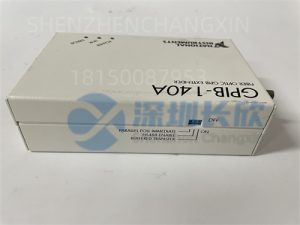
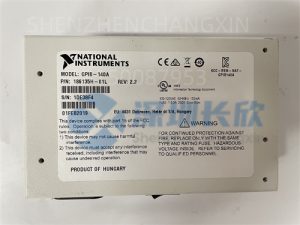
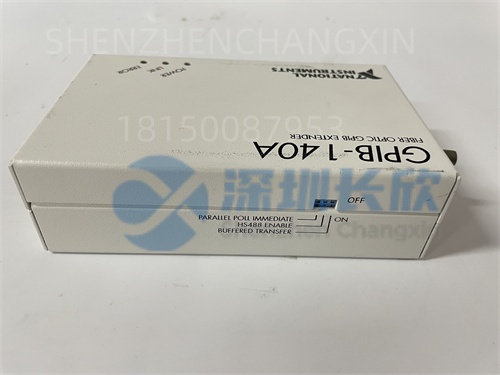
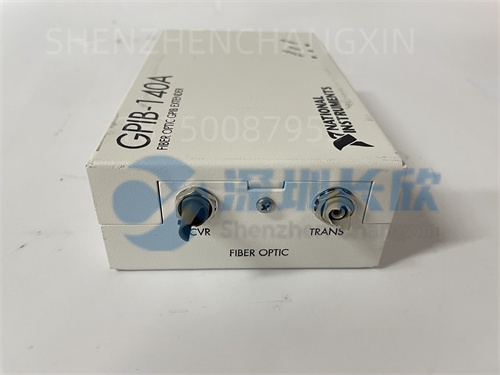
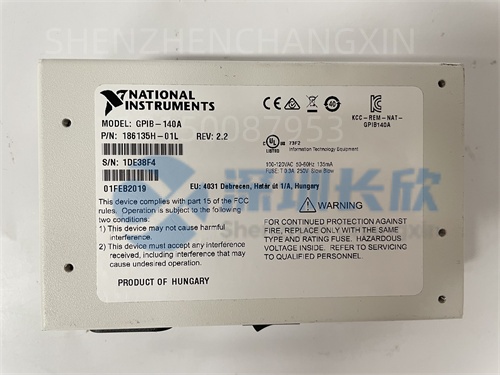
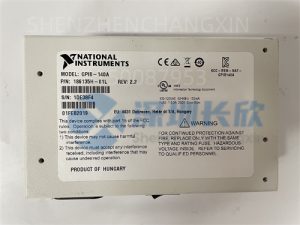
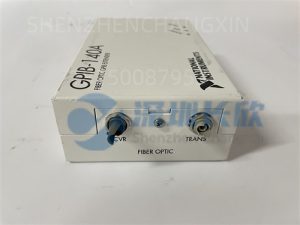
The NI GPIB-140A 186135H-01L is a GPIB (General Purpose Interface Bus, IEEE 488) interface controller card manufactured by National Instruments (NI). The “186135H-01L” suffix typically denotes a specific hardware revision or manufacturing lot code. This card enables a desktop PC or PXI system to act as the Controller on the GPIB bus, allowing it to communicate with and automate a wide array of GPIB-compatible test and measurement instruments, such as oscilloscopes, power supplies, and signal generators. It is a foundational component for building automated test systems in research, development, and production environments.
Application Scenarios
In an electronics manufacturing quality assurance lab, a test engineer needs to validate the performance of a newly assembled RF amplifier module. The test requires configuring a signal generator, capturing waveforms on an oscilloscope, and measuring output power with a spectrum analyzer—all repeatedly and with precise timing. Manually operating each instrument is slow and prone to error. The engineer installs the NI GPIB-140A 186135H-01L card into a control PC. Using NI LabVIEW or NI-488.2 software, they write a program that sends SCPI commands over the GPIB bus. The program automatically sets the generator’s frequency and amplitude, triggers the scope capture, reads the measurement from the spectrum analyzer, and logs the data against pass/fail limits. The GPIB-140A reliably handles this multi-instrument communication, enabling the execution of hundreds of complex test sequences overnight, directly addressing the pain points of manual testing inefficiency and data inconsistency.
Parameter
Based on the standard NI GPIB-140A specifications; the exact parameters for revision 186135H-01L may vary. Consult official NI documentation for precise details.
Technical Principles and Innovative Values
The NI GPIB-140A represents a mature but crucial technology for instrument control, valued for its robustness and standardization.
Innovation Point 1: Reliable, Standardized Instrument Interfacing. Before widespread Ethernet (LXI) and USB instrument control, GPIB was the de factostandard. The GPIB-140A provides a hardware-standardized, daisy-chainable bus that allows up to 14 devices to be connected with a single controller card. Its electrical and protocol specifications ensure reliable communication over distances up to 20 meters, minimizing timing and data integrity issues common in early serial or proprietary interfaces.
Innovation Point 2: Seamless Integration with NI’s Software Ecosystem. The card’s primary innovation lies in its deep integration with NI LabVIEW and the NI-488.2 driver stack. This allows engineers to control instruments using high-level, graphical programming blocks (VIs) rather than low-level register programming. This abstraction layer dramatically reduces development time for automated test systems and makes the system maintainable and scalable.
Innovation Point 3: Enabling Legacy System Longevity and Hybrid Systems. In many industries, capital equipment like high-end analyzers or signal sources have decades-long lifespans and often feature only GPIB interfaces. The GPIB-140A acts as a critical bridge, allowing these valuable legacy instruments to be integrated into modern PC-based test executives and data management systems. This protects prior investments and enables the creation of hybrid systems that combine old and new technology.
Application Cases and Industry Value
Case Study: Semiconductor Parametric Test Station Modernization
A semiconductor research lab operated a suite of precision parameter analyzers and switch matrices from the 1990s, all controlled via GPIB by an aging workstation. The proprietary software was obsolete, and data collection was manual. The lab needed to automate testing and integrate results into a modern database without replacing millions of dollars worth of still-accurate instrumentation.
Implementation & Outcome: The lab installed new industrial PCs with NI GPIB-140A cards into the test racks. Using NI LabVIEW, they developed a new test application that replicated and extended the functionality of the old software. The GPIB-140A cards provided flawless communication with the legacy instruments. The new system automated complex sweep and measurement sequences, reduced test time per device by 70%, and automatically uploaded structured data to a SQL database. The project demonstrated a tenfold return on investment by avoiding instrument replacement costs. The GPIB-140A’s reliability and perfect driver compatibility were cited as key enablers for the successful modernization of the critical research infrastructure.
Related Product Combination Solutions
A complete GPIB-based test system involves several complementary components:
NI GPIB Cables (e.g., NI 888740-xx): Shielded GPIB cables of various lengths (0.5m, 1m, 2m) to daisy-chain instruments, ensuring signal integrity.
NI GPIB-USB Series Converters (e.g., GPIB-USB-HS): External converters that allow a modern laptop or PC without a PCI slot to control GPIB instruments via USB, offering portability.
NI PXI Chassis and Controllers: For modular, high-performance systems, a PXI chassis with an embedded controller and a PXI variant of the GPIB-140A card can be used.
NI Switch Blocks (e.g., PXI-25xx series): To multiplex signals from multiple devices under test to a single set of measurement instruments, controlled via the same GPIB or PXI bus.
NI LabVIEW Professional Development System: The primary software environment for developing the automated test sequences that command the instruments connected via the GPIB-140A.
NI Measurement & Automation Explorer (MAX): Configuration utility that helps identify all GPIB instruments on the bus, assign addresses, and test communication.
Installation, Maintenance, and Full-Cycle Support
Installation: Power down the computer and install the NI GPIB-140A 186135H-01L card into an available PCI slot, securing it with the bracket screw. Connect a GPIB cable from the card’s port to the first instrument in the daisy chain. Power on the system and install the latest compatible version of the NI-488.2 driver software from NI’s website. Use NI MAX to scan the bus, assign unique addresses (0-30) to each instrument, and verify communication.
Maintenance: The card itself requires minimal physical maintenance. Ensure the computer’s cooling is adequate to prevent overheating. Periodically check cable connections for tightness. The primary maintenance is software-based: keep the NI-488.2 drivers updated for compatibility with newer operating systems. If communication issues arise, use MAX’s interactive utility to send simple commands and isolate whether the problem is with the card, cable, or instrument.
Full-Cycle Support: We provide comprehensive support for the NI GPIB-140A 186135H-01L, from identifying the correct card for your system’s bus type (PCI/PXI) to supplying guaranteed genuine or certified refurbished units. Our technical team can assist with driver configuration, address conflicts, and integration planning for your automated test system. We understand the critical role of reliable instrument control in your operations.