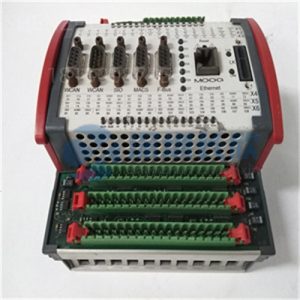
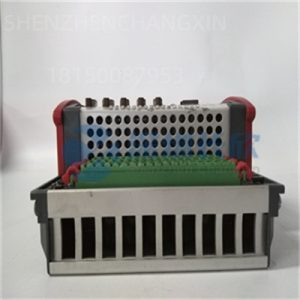
Industrial Automation: MOOG D136-001-007 Servovalve Driver for Safety-Critical Systems
In high-performance industrial automation—particularly in aerospace testing, power turbine control, and heavy machinery—the precision of hydraulic actuation can mean the difference between controlled operation and catastrophic failure. At the heart of such systems lies the MOOG D136-001-007 servovalve driver, a rugged, high-fidelity electronic amplifier engineered to deliver deterministic, low-latency control of electrohydraulic servovalves in safety-critical applications. Unlike generic analog drivers, the D116-001-007 (commonly referenced under its full part number D136-001-007) integrates advanced diagnostics, fail-safe logic, and robust signal conditioning to ensure that every milliamp of command current translates into exact mechanical motion—without drift, overshoot, or delay. For industries where human safety, environmental integrity, and asset protection are non-negotiable, this module is not just a component; it’s a guardian of system fidelity.
Precision Control Meets Functional Safety
The MOOG D136-001-007 is designed specifically to drive Moog’s J-series and similar two-stage flow or pressure control servovalves, which are widely used in applications demanding sub-millisecond response and micron-level positioning accuracy. The driver accepts a ±10 V analog command signal from a PLC, motion controller, or safety system and converts it into a precisely regulated current output (typically ±80 mA) to the torque motor of the servovalve.
What sets the D136-001-007 apart is its dual-channel architecture with independent monitoring. Each channel features:
High-bandwidth current regulation (up to 200 Hz)
Temperature-compensated gain stability
Built-in ramp generators for smooth acceleration/deceleration
Real-time coil resistance monitoring to detect open or short circuits
Critically, the unit includes a hardware-based watchdog and fault detection circuitry that continuously verifies signal integrity. If a command signal is lost, exceeds range, or exhibits abnormal slew rates, the driver can force the valve to a predefined safe state—such as null position or spring-centered hold—within milliseconds. This behavior aligns with IEC 61508 SIL 2 requirements, making the D136-001-007 suitable for use in integrated safety instrumented systems (SIS) when properly architected.
Real-World Applications Where Every Microsecond Counts
Steam Turbine Bypass System – Combined-Cycle Power Plant
At a 1.000 MW facility in Southeast Asia, rapid steam dump valves must open within 200 ms during turbine trip events to prevent boiler overpressure. Legacy drivers suffered from thermal drift and inconsistent response during hot restarts. After upgrading to MOOG D136-001-007 units, engineers observed consistent valve stroke times across ambient temperatures from 25°C to 50°C. “The driver’s temperature compensation eliminated our seasonal tuning headaches,” said the controls lead. “More importantly, during a recent emergency shutdown, all bypass valves responded in under 180 ms—well within spec.”
Flight Control Actuator Test Rig – Aerospace R&D Center
An aircraft manufacturer uses hydraulic test stands to simulate flight loads on primary control surfaces. These rigs require bidirectional force control with <0.5% hysteresis and zero steady-state error. The D136-001-007’s high linearity and low noise floor enabled repeatable test profiles at 100 Hz bandwidth. “We needed a driver that wouldn’t add uncertainty to our certification data,” explained a senior test engineer. “Moog’s unit became part of our measurement chain—not just the actuation chain.”
Offshore Crane Anti-Sway System – North Sea Platform
Heavy-lift cranes on floating platforms use active heave compensation to stabilize loads in rough seas. Hydraulic cylinders, controlled by Moog servovalves driven by D136-001-007 modules, counteract vessel motion in real time. During a storm with 4-meter wave heights, the system maintained load sway below 15 cm—preventing potential collision or dropped cargo. “Reliability here isn’t about uptime—it’s about preventing a life-threatening incident,” noted the offshore automation supervisor.
Integration Best Practices and Expert Insights
Successful deployment of the MOOG D136-001-007 hinges on more than correct wiring. Seasoned integrators emphasize several key considerations:
“Treat the driver like part of your safety logic—not just an amplifier. Its fault outputs should feed directly into your safety PLC’s inputs, not just an alarm panel.”
— Senior Hydraulics Engineer, Global Energy OEM
1. Signal Conditioning and Grounding
Use shielded, twisted-pair cables for both command and feedback signals. Ground the shield at the controller end only to avoid ground loops. Install ferrite chokes near the driver terminals if EMI from VFDs or welding equipment is present.
2. Power Supply Stability
The D136-001-007 requires a clean ±15 VDC supply with low ripple (<50 mVpp). Use dedicated linear regulators—not switched-mode supplies—for critical axes. Voltage sags can cause gain shifts or false fault triggers.
3. Safe State Configuration
During commissioning, define the “fail-safe” behavior based on process risk:
Fail-to-null: Returns valve to neutral (common in test rigs)
Fail-hold: Maintains last position via latching logic (used in some lifting systems)
Fail-close/open: Drives to extreme position (typical in emergency isolation)
This behavior is configured via internal jumpers or external enable signals—never left to default.
4. Diagnostic Integration
The module provides discrete fault outputs (e.g., Valve Fault, Power OK, Enable Status) that should be hardwired to a safety-rated PLC input. Additionally, analog monitoring points allow logging of coil current and temperature for predictive maintenance.
Why It Endures in an Age of Digitalization
While newer digital servo drivers with EtherCAT or CANopen interfaces are gaining traction, the MOOG D136-001-007 remains widely specified due to its proven reliability, simplicity, and immunity to network latency. In safety-critical hydraulic systems, many engineers prefer deterministic analog control over packet-based communication—where even a 1 ms jitter could destabilize a closed-loop system.
Moreover, Moog continues to support the D136 series with long-term availability commitments, calibration services, and firmware-equivalent replacements—essential for industries with 20+ year asset lifecycles.
Conclusion: Engineering Trust into Every Command Cycle
The MOOG D136-001-007 servovalve driver exemplifies a fundamental principle in industrial automation: that true performance is measured not in peak specs, but in consistency under stress. By combining precision analog control with embedded safety intelligence, it ensures that when a turbine trips, a crane lifts, or a test rig simulates Mach 2 conditions, the hydraulic response is exactly as commanded—no more, no less.
For engineers designing or maintaining safety-critical motion systems, this driver is more than hardware. It’s a silent assurance that the link between digital intent and physical action remains unbroken, even when everything else is in flux.