
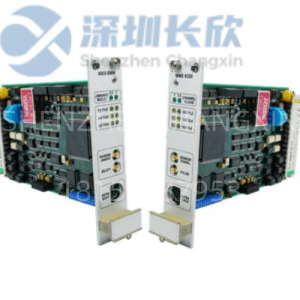
In the world of industrial machinery protection, real-time visibility into critical parameters can mean the difference between a controlled intervention and a catastrophic failure. The EPRO SDM010—a compact, panel-mounted diagnostic display—serves as an essential local interface for EPRO’s widely deployed MMS6110 and MMS6210 vibration and speed monitoring modules. Designed for direct mounting on control cabinets or machine skids, the SDM010 delivers immediate, at-a-glance access to key health indicators such as shaft vibration, rotational speed, bearing temperature, and alarm status—without requiring a laptop, network connection, or central workstation. In environments where seconds count and remote diagnostics aren’t always feasible, this unassuming yet highly functional display becomes a frontline tool for operators, maintenance technicians, and reliability engineers alike.
Bridging the Gap Between Field Data and Human Insight
While modern condition monitoring systems excel at aggregating data in centralized platforms, there remains a persistent need for local, real-time feedback at the machine level. During commissioning, troubleshooting, or emergency response, personnel often work directly beside turbines, compressors, or pumps—where pulling up software on a distant HMI is impractical or too slow. The EPRO SDM010 addresses this gap by providing a dedicated, low-latency window into the signals processed by the MMS6110 (for vibration) and MMS6210 (for speed/tachometry) modules.
Connected via a simple serial link (typically RS-485 using EPRO’s proprietary protocol), the SDM010 continuously polls the host module and displays up to four configurable parameters simultaneously on its high-contrast LCD screen. Common readouts include:
Peak-to-peak shaft displacement (µm or mils)
RMS casing vibration velocity (mm/s or in/s)
Rotational speed (RPM) with direction indication
Alarm and danger relay status (e.g., “ALARM ACTIVE”)
This immediacy has proven invaluable in fast-paced scenarios. At a natural gas compression station in Texas, a field technician noticed abnormal vibration readings on the SDM010 during a routine walkdown—long before the central SCADA system triggered an alert due to communication latency. A subsequent inspection revealed a cracked coupling hub. “The SDM010 gave us early warning right at the source,” said the site’s lead mechanic. “We shut it down safely during the next scheduled window—no forced outage, no collateral damage.”
User-Centric Design for Industrial Environments
Despite its small footprint (typically 96 x 96 mm panel cutout), the SDM010 is engineered for durability and usability in harsh settings. Its features reflect deep understanding of real-world operational needs:
Backlit monochrome LCD ensures readability in low-light turbine halls or bright outdoor installations
IP65-rated front panel protects against dust and water jets—critical for washdown areas or humid coastal plants
Three programmable function keys allow users to toggle between parameter groups, acknowledge alarms, or initiate test modes
Configurable units and scaling support global deployment (metric/imperial, Hz/RPM, etc.)
Wide operating temperature range (0°C to +55°C) accommodates most indoor industrial environments
Unlike generic HMI panels that require complex programming, the SDM010 is configured directly through the MMS6110/6210 module using EPRO’s MMS System Manager software. Engineers define which tags appear on the display, their update rate, and alarm thresholds—all without touching the SDM010 itself. This simplifies deployment and ensures consistency across multi-machine sites.
Enhancing Safety and Operational Efficiency
The presence of an SDM010 significantly improves both safety and workflow efficiency. During startup sequences, operators can verify that vibration levels remain within acceptable limits before ramping to full speed—reducing the risk of rubs or thermal bow. In maintenance bays, alignment crews use real-time displacement readings from the SDM010 to fine-tune coupling offsets, achieving precision that would otherwise require portable analyzers.
Moreover, the display supports alarm acknowledgment at the source. When a vibration threshold is exceeded, the SDM010 flashes a visual warning and can trigger a local buzzer (if equipped). Authorized personnel can press the “ACK” key to silence the local alarm while ensuring the event remains logged in the central system—a crucial feature for distinguishing transient events from persistent faults.
A European hydroelectric plant retrofitted SDM010 units across its generator fleet after repeated incidents of delayed response to bearing overheating. “Before, operators had to radio the control room to check status,” explained the plant manager. “Now, they see it instantly on the cabinet. Response time dropped from 15 minutes to under two.”
Integration Within the Broader EPRO MMS Architecture
Although designed for local use, the SDM010 is not isolated from the larger monitoring ecosystem. It functions as a complementary layer within EPRO’s MMS 6000 platform, coexisting with central servers, remote HMIs, and enterprise analytics tools. Data shown on the SDM010 is identical to what appears in MMS Analyzer or System Manager—ensuring consistency across all access points.
This layered approach aligns with ISA-95 and IEC 62443 principles: critical operational data is available locally for immediate action, while historical trends and advanced diagnostics remain accessible centrally for strategic decision-making. For facilities pursuing ISO 55000 asset management certification, the SDM010 provides tangible evidence of “visible condition monitoring” at the asset level—a frequently cited best practice.
Expert Recommendations for Deployment
To maximize the utility of the EPRO SDM010. industry professionals recommend:
Mount displays at eye level near primary access points—such as coupling guards or bearing housings—to encourage regular visual checks.
Label each parameter clearly (e.g., “LP TURBINE – BEARING 3 VIB”) to avoid confusion in multi-machine panels.
Enable backlight timeout to extend LCD life in continuously lit environments.
Use shielded cable for the RS-485 link, especially when running parallel to power conductors, to prevent communication errors.
Include SDM010 status in operator rounds checklists—treating it as a vital instrument, not just an accessory.
Additionally, ensure firmware versions between the SDM010 and its host MMS6110/6210 module are compatible; newer releases often add support for additional parameter types or improved refresh rates.
Conclusion
The EPRO SDM010 may lack the processing power of a full-fledged controller or the graphical richness of a modern touchscreen HMI, but its strength lies in focused simplicity. By delivering critical machinery health data directly at the point of need, it empowers frontline personnel to make faster, more informed decisions—enhancing both safety and reliability. In an age of cloud analytics and AI-driven predictions, the SDM010 reminds us that sometimes the most effective diagnostic tool is the one you can see, touch, and trust without logging in. As one veteran reliability engineer aptly summarized: “Data is only useful if it reaches the right person at the right time. The SDM010 makes sure it does.”