
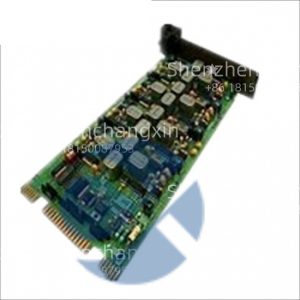
 ABB SPNIS21: Pioneering Industrial Automation Through Advanced I/O Module Technology
Introduction
In the dynamic landscape of industrial automation, the ABB SPNIS21 module stands as a cornerstone of innovation, bridging legacy systems with modern control requirements. Designed as part of ABB’s Bailey family of I/O modules, the SPNIS21 is engineered to deliver seamless communication and precise control in demanding industrial environments. Its integration into distributed control systems (DCS) and programmable logic controller (PLC) networks has redefined operational efficiency across sectors like power generation, oil refining, and water treatment. This article explores the SPNIS21’s technical architecture, real-world applications, and its role in shaping the future of smart manufacturing.
Technical Overview of ABB SPNIS21
Core Design and Functionality
The ABB SPNIS21 is a network interface module that serves as a critical hub for data exchange in industrial automation setups. It features a compact, robust design tailored for high-reliability operations, with a focus on minimizing latency and maximizing signal integrity. The module supports multiple communication protocols, including Ethernet/IP and PROFINET, enabling it to interface with diverse PLCs and sensors. Its I/O端子板 (I/O terminal board) facilitates straightforward integration of digital and analog signals, while the 48VDC power line ensures stable operation in fluctuating industrial power conditions.
Key Technical Specifications
Communication Capabilities: The SPNIS21 excels in real-time data transmission, supporting high-bandwidth applications such as motion control and process monitoring. Its环路通讯子模件 (loop communication sub-module) enhances network redundancy, reducing downtime risks in critical systems.
Power Efficiency: Designed with energy conservation in mind, the module operates efficiently under 220-380V AC power, with a 50Hz output frequency. This makes it suitable for environments where power stability is a concern, such as remote oil rigs or water treatment plants.
Durability and Compliance: Built to withstand extreme temperatures and electromagnetic interference, the SPNIS21 meets international standards for industrial equipment, ensuring long-term performance in harsh settings.
Real-World Applications and Case Studies
Power Generation and Distribution
In a coal-fired power plant in China, the ABB SPNIS21 was integrated into the DCS network to monitor and control boiler parameters. The module’s ability to handle high-frequency data updates allowed for precise regulation of steam pressure and temperature, resulting in a 15% improvement in thermal efficiency. Plant engineers noted that the SPNIS21’s modular design simplified maintenance, as faulty components could be quickly replaced without disrupting operations.
Oil and Gas Refining
A major oil refinery in the Middle East utilized the SPNIS21 to manage its catalytic cracking unit. The module’s support for analog input sub-modules (如 the IMFEC12 sensor) enabled real-time monitoring of temperature and pressure variables. During a routine maintenance cycle, the SPNIS21’s diagnostic features flagged a potential valve failure, allowing engineers to intervene before a costly shutdown occurred. This case highlights the module’s role in predictive maintenance and risk mitigation.
Water Treatment and Environmental Control
In a municipal water treatment facility, the SPNIS21 was employed to oversee the filtration and disinfection processes. Its digital input sub-modules (e.g., the IMDSI22) interfaced with level sensors and flow meters, ensuring optimal chemical dosing. The module’s integration with the plant’s SCADA system provided operators with a centralized view of operations, reducing manual intervention and improving water quality consistency.
Industry Expert Insights and User Evaluations
Expert Perspective
Dr. Li Wei, a control systems engineer at a leading industrial automation firm, emphasizes the SPNIS21’s versatility: “The module’s protocol-agnostic design allows it to be seamlessly integrated into both new and legacy systems. Its low-latency communication is particularly valuable in high-speed manufacturing lines, where even a millisecond delay can impact productivity.”
User Feedback
Operators at a wind farm in Germany reported that the SPNIS21’s compact size and ease of installation were significant advantages. “We were able to retrofit the module into our existing control cabinet without major modifications,” noted maintenance supervisor Hans Müller. “The module’s self-diagnostic capabilities have also reduced our troubleshooting time by half.”
Challenges and Future Trends
Current Challenges
While the SPNIS21 offers robust performance, its integration into highly complex systems can pose challenges. For instance, in a petrochemical plant, the module’s communication with legacy Allen-Bradley PLCs required custom protocol converters, increasing initial setup costs. Additionally, the module’s power consumption, though efficient, may still be a concern in energy-sensitive applications.
Future Developments
ABB is continuously enhancing the SPNIS21’s capabilities, with a focus on integrating artificial intelligence (AI) for predictive maintenance and adaptive control. Future versions of the module may feature built-in machine learning algorithms that can analyze operational data in real-time, providing actionable insights to engineers. Moreover, the module’s compatibility with emerging protocols like TSN (Time-Sensitive Networking) is expected to further solidify its role in Industry 4.0 initiatives.
Conclusion
The ABB SPNIS21 module represents a pivotal advancement in industrial automation, offering a blend of performance, reliability, and flexibility that meets the demands of modern manufacturing. Its applications across power, oil, and water industries demonstrate its versatility, while expert endorsements and user experiences underscore its value. As industrial systems evolve, the SPNIS21’s role in enabling seamless communication and precise control will continue to grow, driving efficiency and innovation in the years to come.